Birds of a Feather is back with our new blog, Birding and Bonding! Our previous objective remains the same. Our goal is to find all birds that live on Long Island year round. The only rule is that in order to add a bird to our list, we must see it when we are together. That's where the bonding comes in. Life can get so hectic that we sometimes fail to enjoy the more important things. This gives us a wonderful outlet to make sure we take the time.

Of course, Long Island has many migratory birds, as well. We certainly don't want to ignore them. We will blog about them as well. Armed with new cameras and renewed incentive, we look forward to getting back on the birding trail!

Friday, September 10, 2010

Hawk Mountain countdown...

If all in the world were good, San and I would be planning our first Hawk Mountain excursion for next week.  But her schedule is in a state of flux for now.  
So I am not sure when or if we will make it there this migatory season.  This is a partial list of what has been seen so far.

2010 Autumn Hawk Count
Daily Total for 9/9/2010
0 Black Vulture
0 Turkey Vulture
0 Northern Goshawk
39 Sharp-shinned Hawk
1 Cooper's Hawk
1 Unidentified Accipiter
2 Red-tailed Hawk
0 Red-shouldered Hawk
17 Broad-winged Hawk
0 Rough-legged Hawk
1 Unidentified Buteo
0 Golden Eagle
10 Bald Eagle
0 Unidentified Eagle
0 Northern Harrier
16 Osprey
0 Peregrine Falcon
3 Merlin
16 American Kestrel

All birders should try and get to Hawk Mountain, it truly is a great experience.  I am listing below a few other upcoming events at Hawk Mountain.  Join in the activity or just sit and watch the Raptor's parade above.


2010 Autumn Hawkwatch
pair_vultures_one_with_wingtag.jpg


Daily, August 15-December 15 at North Lookout

Make an annual pilgrimage to Hawk Mountain and take part in the oldest and longest running migration watchsite on the planet. Counters and interns are stationed every day at North Lookout where they will help spot and identify birds. Like other migration watchsites, the number and type of birds will depend upon the temperature, the wind direction, and the time of year, which makes hawkwatching part sport, part fun, and part a little luck. But whether the birds fly or not, every day is a good day on Hawk Mountain, so come ready with snacks and water and settle back to take in the big views, and with any luck, some great looks at hawks, eagles and falcons.


monarch are black eye  susan.jpgMonarch Migration Celebration
Saturday, September 18 from 10 am-4 pm
Trail fee applies for Non-members

Visit Hawk Mountain for a full day devoted to the amazing migration of the Monarch Butterfly. Programs on this day will focus on this tiny non-raptor migrant and its long and dangerous journey to Mexico, the importance of native plants to the Monarch's survival, and how scientists study such tiny migrants.

Volunteer and Monarch Biologist John Drummond will be on hand to provide Monarch tagging demonstrations at the Visitor Center. Meanwhile at the Lookout, visitors will find this is a great time to look for monarchs fluttering past, enroute to Mexico, and we'll have educators on hand to provide information and point out passing butterflies.
In the Native Plant Garden, we're planning special programs on the importance of milkweed, and indoors, children may take part in some great activities that will connect them with other young people in Mexico.
Weather permitting, the highlight will come after an end-of-day program in the Amphitheater followed by an impressive en-masse release of all the Monarchs tagged throughout the day. This is a day you won't want to miss, and we look forward to helping you learn more about the migration of ALL creatures.
Note: To protect the butterflies, temperatures below 60 degrees must cancel the mass release
 
eaglewatchers.gifThe Eagle Watchers
Saturday, September 18 at 5 pmVisitor Center
Join Drs. Ruth Tingay, President of the Raptor Research Foundation, and Todd Katzner, director of conservation science at The National Aviary, for an interesting and informative slideshow program on the new book, The Eagle Watchers. Both Ruth and Todd are two of the first Hawk Mountain leadership interns and together, co-authored this 256-page book about some of the most impressive raptors in the world. Eagle Watchers is a collection of essays written by people who have devoted their lives to studying, watching and enjoying eagles.

The great news about this book is that Ruth and Todd have generously offered to donate 100% of all their book royalties to the Hawk Mountain internship program and the National Birds of Prey Trust, which makes this one book you really feel good about reading. Todd and Ruth will be on hand to sign books after the program.

Children's Raptor ID WorkshopSunday, September 19 from 10 am-1:30 pm
$10 Members, $20 Non-Members
Limited to 10 children ages 8 to 12

A great program for the up-and-coming young birder! Using slides and video, Laurie Goodrich and Denise Peters will help children learn the basics of raptor identification with a special focus on buteos and eagles. The indoor lesson will be followed by a hike to the lookout to practice newly-learned skills. Children should bring a daypack with lunch, water and something soft to sit on, and should dress in warm layers. Binoculars will be provided along with a lesson on their proper use. Sorry parents, this program is designed for the kids, so you may follow along at a distance, or we'll meet you back at the Visitor Center at 1:30.
Advance registration is required: call 610-756-6961.


shrooms.jpgMushroom ID Workshop with Joe Lankalis
Sunday, September 19 at 2 pm
The Common Room
$5 Members, $10 Non-Members
Limited to 15 participants

Join the Master of Mushrooms, Joe Lankalis, for a workshop on mushroom identification. Since weather is unpredictable, Joe asks that each participant collect mushrooms from his or her area on Saturday, then bring the samples to the workshop on Sunday. This provides a great variety of fungi to examine and identify. If weather happens to be ideal for mushroom growth, the program may end with a short walk to examine what's popping around the Common Room.
Advance registration required, call 610-756-6961


Hawk Mountain Art Show at CabelasSat & Sun, September 25-26
10 am-5 pm, Cabela's; Located in Deer Country exhibit

Meet award-winning artists and view a mix of wildlife and nature-inspired art at this exhibit and sale designed to introduce Cabela's customers to the Sanctuary. This event is organized by local volunteers and artists, so consider taking a moment to stop by and thank them for their participation.


hawk_mountain_coffee_table.jpgAUTUMN LECTURE
Hawk Mountain: The World's First Raptor Sanctuary
Saturday, October 2
5 pm. Free
Meet coffee-table book author Jim Wright and photographer Kevin Watson and enjoy a wonderful slideshow that consolidates the hundreds of images taken over two years during the creation of their photo essay book, "Hawk Mountain." Jim will share stores from the dozens of personal interviews and visits, providing his unique insight into the Mountain, its history and the people (and wildlife!) who make the Sanctuary special.

Meet the Fall ForestSaturday, October 2 from 1-2:30 pm
Limited to first 12 who sign up in the Visitor Center on day of event
Trail fee applies. Pay trail fee when you sign up.

Join seasoned botanist and Kutztown University Professor of Biology Dr. Chris Sacchi for a laid back introduction to the autumn forest during this guided walk around the Visitor Center, Native Plant Garden and some sections of the trail. Dr. Sacchi will show you how to identify trees, shrubs and herbs by their changing shades and will explains how the forest community prepares for winter to ensure survival next spring.

Wednesday, September 8, 2010

Did you know...

Did you know that originally the State bird of New York was the American Robin?  The Robin red breast or American robin was initially selected as the state bird of New York, but a campaign by Mrs. Charles Cyrus Marshall, President of the New York Federated Women's Clubs, in 1927 and 1928 determined that the bluebird was more popular.

It took over forty years however to adopt the bluebird as the official state bird of New York. The legislation adopting the bluebird as the official state bird was signed by Governor Nelson Rockefeller on May 18, 1970.


You can find Eastern Bluebirds in open country with patchy vegetation and large trees or nest boxes. Meadows, old fields, and golf courses are good places. Bluebirds typically sit in the open on power lines or along fences, with an alert, vertical posture. When they drop to the ground after an insect, they make a show of it, with fluttering wings and a fairly slow approach, followed by a quick return to the perch. 
Insects caught on the ground are a bluebird’s main food for much of the year. Major prey include caterpillars, beetles crickets, grasshoppers, and spiders. In fall and winter, bluebirds eat large amounts of fruit including mistletoe, sumac, blueberries, black cherry, tupelo, currants, wild holly, dogwood berries, hackberries, honeysuckle, bay, pokeweed, and juniper berries.
 
Eastern Bluebirds put their nests in natural cavities or in nest boxes or other artificial refuges. Among available natural cavities, bluebirds typically select old woodpecker holes in dead pine or oak trees, up to 50 feet off the ground. Older bluebirds are more likely than younger ones to nest in a nest box, although individual birds often switch their preferences between nesting attempts. When given the choice in one study, bluebirds seemed to prefer snugger nest boxes (4 inches square instead of 6 inches square on the bottom) with slightly larger entrance holes (1.75 inch rather than 1.4 inch diameter).  I will try next season to attract Bluebirds to my yard.  Hey, you never know.

Bluebird populations fell in the early twentieth century as aggressive introduced species such as European Starlings and House Sparrows made available nest holes increasingly difficult for bluebirds to hold on to. In the 1960s and 1970s establishment of bluebird trails and other nest box campaigns alleviated much of this competition, especially after people began using nest boxes designed to keep out the larger European Starling. Eastern Bluebird numbers have been recovering since.

This small, brightly colored thrush typically perches on wires and fence posts overlooking open fields. The birds forage by fluttering to the ground to grab an insect, or occasionally by catching an insect in midair. Bluebirds can sight their tiny prey items from 60 feet or more away. They fly fairly low to the ground, and with a fast but irregular pattern to their wingbeats. Males vying over territories chase each other at high speed, sometimes grappling with their feet, pulling at feathers with their beaks, and hitting with their wings. The boxes and tree cavities where bluebirds nest are a hot commodity among birds that require holes for nesting, and male bluebirds will attack other species they deem a threat, including House Sparrows, European Starlings, Tree Swallows, Great Crested Flycatchers, Carolina Chickadees, and Brown-headed Nuthatches, as well as non-cavity nesters such as robins, Blue Jays, mockingbirds, and cowbirds. Males attract females to the nest with a display in which he carries bits of nesting material into and out of the nest. Once a female enters the nest hole with him, the pair bond is typically established and often remains intact for several seasons.

Wednesday, August 25, 2010

Come Rain or Shine

Went to San's for a barbecue over the weekend, and the weather definitely didn't cooperate but the birds did.

Baltimore Oriole
San had all her feeders brimming with seed, and many birds were delighted to say the least.  As always, the Black capped Chickadees seem to have no fear and don't mind being close to humans.  We saw quite a few birds, but the best treat was seeing a male Baltimore Oriole.


With its brilliant orange and black plumage, the Baltimore Oriole's arrival is eagerly awaited by birders each spring migration. Its preference for open areas with tall trees has made it a common inhabitant of parks and suburban areas. San's neighbor has a fruit bearing tree that attracted the Oriole.  The "orioles" of the Americas were named after similarly-appearing birds in the Old World. The American orioles are not closely related to the true orioles in the family Oriolidae. They are more closely related to blackbirds and meadowlarks. Both New and Old world orioles are brightly colored with red, yellow, and black; have long tails and long pointed bills; build hanging, woven nests; and prefer tall trees around open areas.   At one time, this species and the Bullock's Oriole, Icterus bullockii, were considered to be a single species, the Northern Oriole.

This bird received its name from the fact that the male's colors resemble those on the coat of arms of Lord Baltimore. The Lord was an English coloniser who was the first proprietor of the Maryland Colony in the 1600's. He governed Maryland for 42 years and that my friends is how the Baltimore Oriole became the state bird of Maryland.

Saturday, August 14, 2010

A Delightful Afternoon!

As we both always seemed to be pressed for time, we decided to revisit the Hoyt Farm Park Preserve.  It is nearby so we thought it was the best way to use the few hours we had to spare this afternoon.  And being that it was an exceptionally beautiful August day, we thought we might make up for our last visit there, which was rained out.

We went in search of two birds that eluded us the last time, the Cedar Waxwing and the Indigo Bunting.  The Cedar Waxwing is a year-round resident of Long Island, so we were hoping to add this bird to our list.  Unfortunately, we were unable to locate one.  We will try again!

We felt that our venture was a success anyway, because as soon as we arrived at the apple orchard, we were greeted by several Indigo Buntings, chatting amongst themselves.  This bird is here only in the summer.  Alas, he won't be added to our list.  We were so hoping to see some though, because they are so beautiful.  They are the color of Caribbean blue water.  They summer throughout most of the eastern half of the country.  It's a wonder we don't see more of them.  Keep a lookout when passing brushy pastures and fruit orchards.  They winter from southern Florida to Central America and the West Indies. 

Our trek today was a quickie, about three hours, but we really delighted in observing this beautiful bird.  Of course, we saw an array of other local birds that we have blogged about in the past.  What enjoyment there is in such variety!  Until next time.  Keep on birding!

Tuesday, August 10, 2010

The Great Horned Owl

Let me start by saying I haven't ever seen a Great Horned Owl in the wild.  I have though heard them in the woods across the street from my house.  It's a call I am sure many of us have heard, the call is a deep hooting "hoo-h'HOO--hoo-hoo."

The Great Horned Owl is one of the most widespread and common owls in North America. Here are some cool facts about this owl.

They use a variety of nest sites, including trees, cliffs, buildings, and the ground. And they don't make their own nests. They typically take over nests in trees made by other bird species. They often put nests in hollows or broken-off snags in trees.

The Great Horned Owl will take large prey, even other raptorial birds. It regularly kills and eats other owls, and is an important predator on nestling Ospreys. This interesting tidbit is the reason for this particular blog. 

About two weeks ago I was yet again laying in my hammock (By the way, it may seem like I spend a lot of time in my hammock, but I really don't), and when we were putting the cover on it I noticed what looked to be a kill site.  There were feathers everywhere.  Red feathers, so I sent this picture and called my fellow expert birder San to see what she thought. 

We ruled out every bird we could think of that might have these colored feathers.  So I kept looking around and I found the skeleton that went with these feathers.  I know this may seem a tad on the morbid side, but birding involves the entire circle of life. 


Once I examined the skull of this rather large bird I realized that it had to be a Red Tailed Hawk.  So now that I knew what the prey was, it was easy to figure out who the predator was.  In our area, other than humans, Hawk aren't really hunted by anything other than the Great Horned Owl.

Not a happy find, but I was glad I was able to find out what happened to this beautiful creature.

Backyard Birding

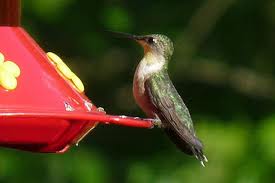
It was such a beautiful day today, so as I had breakfast in my usual spot at my kitchen table.  When I saw our Ruby-throated Hummingbird. And I thought since San and I don't have any outings planned, I should do some backyard birding.

So I will show a pictorial of all the birds I saw that morning and the afternoon when I returned home to spend time in my Hammock.  As soon as the Hawk showed up everyone fled, but it was nice while it lasted.


Downy Woodpecker
Ruby-throated Hummingbird (Female)
American Goldfinch (Male & Female)


Purple Finch (Male & Female)


Common Grackle
                                                                                                                                                                        
House Sparrow


American Robin


House Finch
Red Bellied Woodpecker - Juvenile


Brown-headed Cowbird


Red Tailed Hawk
                                                      

Wednesday, August 4, 2010

Another Mystery Solved!!

Saturday I decided to take it easy and play with my new IPhone while relaxing in my hammock.   I happened to notice a baby bird all by its self.  At first I thought it was a baby Robin, even though it looked like a Sparrow it was much too big to be a Sparrow.

The next day on the ground by my thistle feeders, I actually saw a bird feeding this chick.  It was clearly not the chick of the bird feeding it because it was almost twice as large.  The mother bird was a Chipping Sparrow. 

So I at once called San to tell her of my birding moment.  I am now trying to take pictures while talking to San, but this was no easy task.  The thistle feeders are outside my kitchen window over my sink.  So I can't see the ground from the window so I was snapping pictures blindly, and they actually looked as though someone blind had taken them.  The most I got was a tail in the shot.  Every time I went outside to take a picture the mother bird flew away.  I finally wised up and stood on a stool to snap some pictures.  So the mother kept coming and going so in the meantime I talked to San.  I got so excited when the mother came back that trying to juggle my new phone and my SLR camera that I dropped the camera and scared away the mother bird yet again.

Finally she came back and I was able to get some decent photos of the small Chipping Sparrow feeding this rather large baby bird.

It wasn't until later that night, that I realized what type of bird this chick was.  Earlier in the day I saw alot of Brown-headed Cowbirds, and it donned on me that these birds lay their eggs in other birds nests to raise their young for them.  So as usual I did a little research and this is what I found. 

The Brown-headed Cowbird is a stocky blackbird with a fascinating approach to raising its young. Females forgo building nests and instead put all their energy into producing eggs, sometimes more than three dozen a summer. These they lay in the nests of other birds, abandoning their young to foster parents, usually at the expense of at least some of the host’s own chicks.
The Cowbird will try to lay their eggs in nest's with similar colored eggs.
Cowbird eggs hatch faster than other species eggs, giving cowbird nestlings a head start in getting food from the parents. Young cowbirds also develop at a faster pace than their nest mates, and they sometimes toss out eggs and young nestlings or smother them in the bottom of the nest. As you can see in the picture, the large egg on top is from a Cowbird, and the smaller ones are from a Sparrow. 

This was pretty exciting for a birder that is.  I haven't seen them since, so I am glad I stayed home on Saturday.