First of all, let me apologize for our long absence. It's been a long winter for my birding buddy and myself. Now that spring is in the air, we hope to post more regularly.
I couldn't resist sharing this story with our readers. My girlfriend went to Lake Placid last week with her family and some friends. The Inn they stayed at also housed some foxes, owls, and other wildlife in need of some care.
This vacationing group came in contact with a curious crow.
He appeared to have no fear of humans. Maybe he was a recipient of the kindness of the innkeepers. He would come and land on your outstretched arm. How sweet!! The only problem was that this friendly crow had a strange way of making friends. Perhaps he was a middle child/bird and had to fight to get attention. Or perhaps he suffered with some sort of insecurity complex or anxiety disorder.
In any case, he tried warming up to these friends by pecking on the head of little Silas! All that got him was a shooshing away. Then he tried a love peck on the neck of Norbert. That wasn't too endearing, especially since it drew blood! He proceeded to perch nearby, but this only served to intimidate! It sure is hard making friends!
Fearless Mark decided to capture "the love" on video. Way to go!!!
Hope you enjoyed the video as much as I did. So the next time you see a crow, watch your back! You never know!!
The tales of two forever friends as they share a mutual passion for birds while spending time together.
Birds of a Feather is back with our new blog, Birding and Bonding! Our previous objective remains the same. Our goal is to find all birds that live on Long Island year round. The only rule is that in order to add a bird to our list, we must see it when we are together. That's where the bonding comes in. Life can get so hectic that we sometimes fail to enjoy the more important things. This gives us a wonderful outlet to make sure we take the time.
Of course, Long Island has many migratory birds, as well. We certainly don't want to ignore them. We will blog about them as well. Armed with new cameras and renewed incentive, we look forward to getting back on the birding trail!
Sunday, February 24, 2013
Tuesday, November 27, 2012
Where have all the birds gone?
It is already the end of November and I don't think Sandy and I have managed to go birding more than three times in 2012.
Our goal or quest was to use our love of birding to help us make time to do this together. But alas, this year has someone how eluded us and passed by much to quickly.
Last month I was looking out my kitchen window and I saw my first Dark Eyed Junco. What is remarkable about this is that they only winter on Long Island and if they are here already then where on earth has the year gone?
So here we are on November 27th, and we are trying to plan something for this weekend. But as always there are time constraints we must work with, service and other obligations.
Let's hope we spot some birds!
Our goal or quest was to use our love of birding to help us make time to do this together. But alas, this year has someone how eluded us and passed by much to quickly.
Last month I was looking out my kitchen window and I saw my first Dark Eyed Junco. What is remarkable about this is that they only winter on Long Island and if they are here already then where on earth has the year gone?So here we are on November 27th, and we are trying to plan something for this weekend. But as always there are time constraints we must work with, service and other obligations.
Let's hope we spot some birds!
Monday, October 1, 2012
Birding in Sweden 2012
Okay so first we want to apologize for not blogging sooner. Sometimes life happens and before you know it time has passed us by.
We will try our best to help you see the wonderful birds we saw while we were there.
We landed in Gothenburg Sweden at 5am after being up for almost 24 hours but we dropped off our luggage and began exploring. We took a look at our maps and off we went. We found our way to a park a few miles from the hotel and as we meandered through the gardens we spotted a bird that we could not identify.
So we saw this bird and we were quite perplexed as to what it was. It was black with a grey fuzz type hair piece. Once we researched it we found this bird to be a Eurasian (Western) Jackdaw.
Our research shows that this bird is from the Corvus monedula (Crow Family), sometimes known as the Eurasian Jackdaw, European Jackdaw or simply Jackdaw. Found across Europe, western Asia and North Africa, it is mostly resident, although northern and eastern populations migrate south in winter.
As the days went on, we found ourselves at the Botanical Gardens. It was a beautiful day and we parted from our group of 16 to wander aimlessly through the gardens as we do so well.

We climbed rocks, went out on ledges, crossed waterfalls and stood in amazement as we took in the natural beauty of creation.
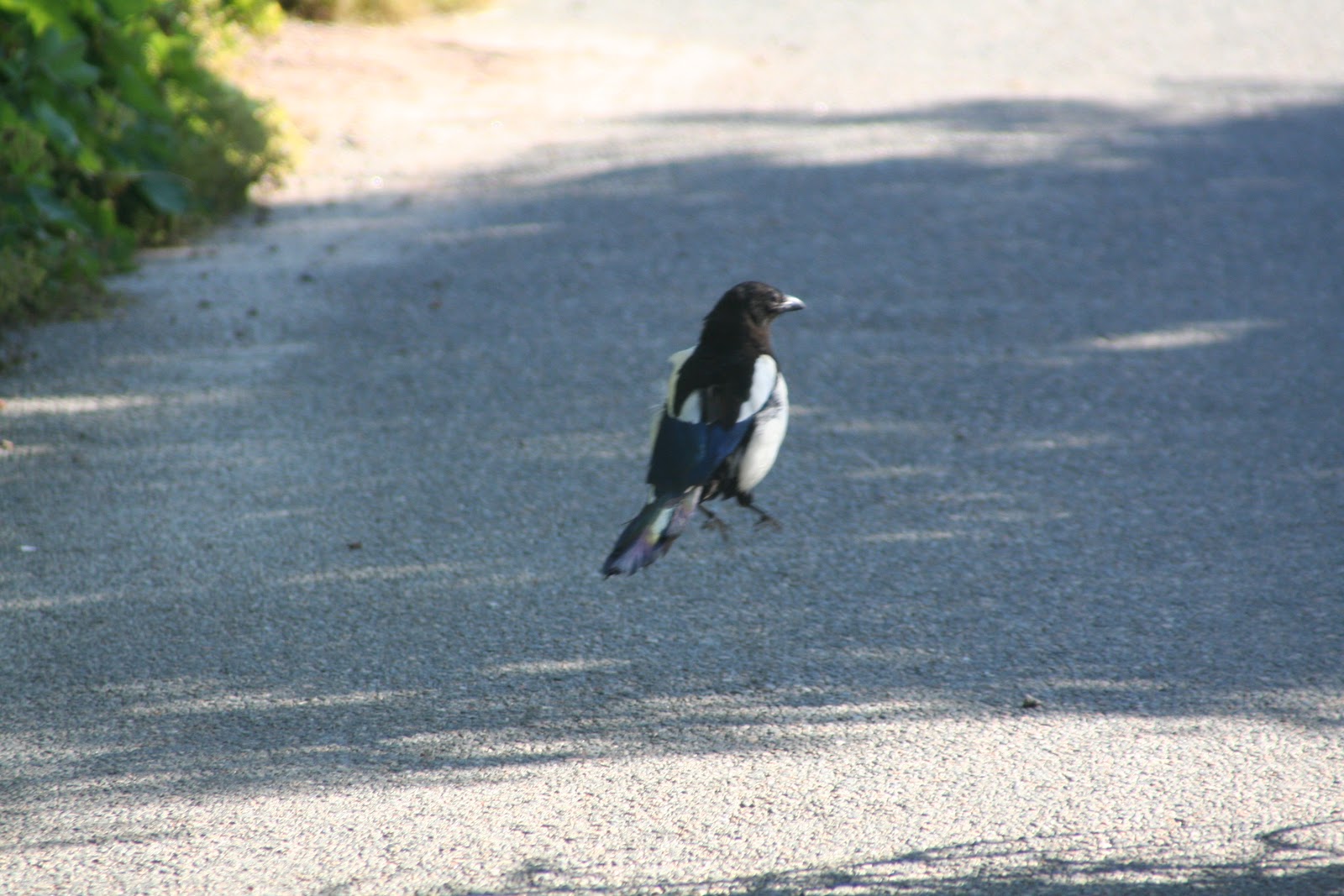
It was here at the gardens that we saw up close the Magpie.
The Eurasian Magpie, European Magpie, or Common Magpie, (Pica pica), is a resident breeding bird throughout Europe, much of Asia and northwest Africa. It is one of several birds in the crow family named as magpies. In Europe, "Magpie" is used by English speakers as a synonym for the European Magpie; it is the only magpie in Europe outside the Iberian Peninsula.
The Eurasian Magpie is one of the most intelligent birds, and it is believed to be one of the most intelligent of all animals.
Other birds flew in and out of our view but we didn't get any other good photo's. So we don't have much to show for it with bird photos but we had a great time.
Hej Da to Sweden!
We will try our best to help you see the wonderful birds we saw while we were there.
We landed in Gothenburg Sweden at 5am after being up for almost 24 hours but we dropped off our luggage and began exploring. We took a look at our maps and off we went. We found our way to a park a few miles from the hotel and as we meandered through the gardens we spotted a bird that we could not identify.
So we saw this bird and we were quite perplexed as to what it was. It was black with a grey fuzz type hair piece. Once we researched it we found this bird to be a Eurasian (Western) Jackdaw.
Our research shows that this bird is from the Corvus monedula (Crow Family), sometimes known as the Eurasian Jackdaw, European Jackdaw or simply Jackdaw. Found across Europe, western Asia and North Africa, it is mostly resident, although northern and eastern populations migrate south in winter.
As the days went on, we found ourselves at the Botanical Gardens. It was a beautiful day and we parted from our group of 16 to wander aimlessly through the gardens as we do so well.We climbed rocks, went out on ledges, crossed waterfalls and stood in amazement as we took in the natural beauty of creation.
It was here at the gardens that we saw up close the Magpie.
The Eurasian Magpie, European Magpie, or Common Magpie, (Pica pica), is a resident breeding bird throughout Europe, much of Asia and northwest Africa. It is one of several birds in the crow family named as magpies. In Europe, "Magpie" is used by English speakers as a synonym for the European Magpie; it is the only magpie in Europe outside the Iberian Peninsula.
Other birds flew in and out of our view but we didn't get any other good photo's. So we don't have much to show for it with bird photos but we had a great time.
Hej Da to Sweden!
Thursday, May 10, 2012
Big Day II
Hard to believe but we went birding twice in one week. After our first Big Day we were so psyched we went out again within the week.
Again we stayed local, first we went on a bird walk with a guide at the Nissequogue River State Park. There were six of us in the group, but must of them seemed to be backyard birders not professional birders like us, lol.
The tour started out on foot and armed with camera's and binoculars we headed over to a pond where we actually saw a new bird for our blog.
We spotted a Gadwall duck. Up close the male shows a remarkable pattern of intricate markings on all of its body feathers with a white patch under his wings.
As we continue our trek thru the woods our guide hears a Chipping Sparrow. Their loud, trilling songs are one of the most common sounds of spring woodlands. We can't add them to our year-round list but it was the first time we spotted them together.
We also saw another bird that we can add to our list an Eastern Towhee (Rufous-sided Towhee) which is a strikingly marked, over sized sparrow of the East, feathered in bold black and warm reddish-browns – if you can get a clear look at it. Eastern Towhees are birds of the undergrowth, where their rummaging makes far more noise than you would expect for their size. Their chewink calls let you know how common they are, but many of your sightings end up mere glimpses through tangles of little stems.
The grounds are beautiful and as we went to one particular spot on the grounds we were told that we have a juvenile Bald Eagle that lives on Long Island year-round.
We searched the skies and all the tops of the trees in search for this Bald Eagle, but it wasn't meant to be this day.
So immediately we made plans to come back until we find our LI Eagle, but at the end of the tour our guide informs us that the State will be demolishing all those abandoned buildings this summer and they will close off portions of the park. This then facilitates the need to get there quickly.
When we made our way back to the pond we saw some turtles taking in the sun and they were joined by some Mallards.


After we left NRSP we decided to head over to Sweetbriar Nature Center. Though they house many different birds and animals we can't count the ones that are caged. There was a Fox, Hawk, Vulture, and a Bald Eagle.
The Nature Center has many trails and supposedly people have spotted Great Blue Heron's so off we go into the woods to see what we can see. But alas it wasn't meant to be. We were trying for 30 birds spotted for the day.
All in all we saw 26 birds this day, walking past the abandoned building of the Psychiatric Hospital now part of the NRSP and along the trails of Sweetbriar.
As birders, when faced with many trails you don't always know which one to take, but no matter the direction, birding with your BFF makes any path chosen the right one.
The tour started out on foot and armed with camera's and binoculars we headed over to a pond where we actually saw a new bird for our blog.
We spotted a Gadwall duck. Up close the male shows a remarkable pattern of intricate markings on all of its body feathers with a white patch under his wings.
As we continue our trek thru the woods our guide hears a Chipping Sparrow. Their loud, trilling songs are one of the most common sounds of spring woodlands. We can't add them to our year-round list but it was the first time we spotted them together.
We also saw another bird that we can add to our list an Eastern Towhee (Rufous-sided Towhee) which is a strikingly marked, over sized sparrow of the East, feathered in bold black and warm reddish-browns – if you can get a clear look at it. Eastern Towhees are birds of the undergrowth, where their rummaging makes far more noise than you would expect for their size. Their chewink calls let you know how common they are, but many of your sightings end up mere glimpses through tangles of little stems.
The grounds are beautiful and as we went to one particular spot on the grounds we were told that we have a juvenile Bald Eagle that lives on Long Island year-round.
We searched the skies and all the tops of the trees in search for this Bald Eagle, but it wasn't meant to be this day.
So immediately we made plans to come back until we find our LI Eagle, but at the end of the tour our guide informs us that the State will be demolishing all those abandoned buildings this summer and they will close off portions of the park. This then facilitates the need to get there quickly.
When we made our way back to the pond we saw some turtles taking in the sun and they were joined by some Mallards.
The Nature Center has many trails and supposedly people have spotted Great Blue Heron's so off we go into the woods to see what we can see. But alas it wasn't meant to be. We were trying for 30 birds spotted for the day.
All in all we saw 26 birds this day, walking past the abandoned building of the Psychiatric Hospital now part of the NRSP and along the trails of Sweetbriar.
As birders, when faced with many trails you don't always know which one to take, but no matter the direction, birding with your BFF makes any path chosen the right one.
Subscribe to:
Posts (Atom)