Birds of a Feather is back with our new blog, Birding and Bonding! Our previous objective remains the same. Our goal is to find all birds that live on Long Island year round. The only rule is that in order to add a bird to our list, we must see it when we are together. That's where the bonding comes in. Life can get so hectic that we sometimes fail to enjoy the more important things. This gives us a wonderful outlet to make sure we take the time.

Of course, Long Island has many migratory birds, as well. We certainly don't want to ignore them. We will blog about them as well. Armed with new cameras and renewed incentive, we look forward to getting back on the birding trail!

Wednesday, August 25, 2010

Come Rain or Shine

Went to San's for a barbecue over the weekend, and the weather definitely didn't cooperate but the birds did.

Baltimore Oriole
San had all her feeders brimming with seed, and many birds were delighted to say the least.  As always, the Black capped Chickadees seem to have no fear and don't mind being close to humans.  We saw quite a few birds, but the best treat was seeing a male Baltimore Oriole.


With its brilliant orange and black plumage, the Baltimore Oriole's arrival is eagerly awaited by birders each spring migration. Its preference for open areas with tall trees has made it a common inhabitant of parks and suburban areas. San's neighbor has a fruit bearing tree that attracted the Oriole.  The "orioles" of the Americas were named after similarly-appearing birds in the Old World. The American orioles are not closely related to the true orioles in the family Oriolidae. They are more closely related to blackbirds and meadowlarks. Both New and Old world orioles are brightly colored with red, yellow, and black; have long tails and long pointed bills; build hanging, woven nests; and prefer tall trees around open areas.   At one time, this species and the Bullock's Oriole, Icterus bullockii, were considered to be a single species, the Northern Oriole.

This bird received its name from the fact that the male's colors resemble those on the coat of arms of Lord Baltimore. The Lord was an English coloniser who was the first proprietor of the Maryland Colony in the 1600's. He governed Maryland for 42 years and that my friends is how the Baltimore Oriole became the state bird of Maryland.

Saturday, August 14, 2010

A Delightful Afternoon!

As we both always seemed to be pressed for time, we decided to revisit the Hoyt Farm Park Preserve.  It is nearby so we thought it was the best way to use the few hours we had to spare this afternoon.  And being that it was an exceptionally beautiful August day, we thought we might make up for our last visit there, which was rained out.

We went in search of two birds that eluded us the last time, the Cedar Waxwing and the Indigo Bunting.  The Cedar Waxwing is a year-round resident of Long Island, so we were hoping to add this bird to our list.  Unfortunately, we were unable to locate one.  We will try again!

We felt that our venture was a success anyway, because as soon as we arrived at the apple orchard, we were greeted by several Indigo Buntings, chatting amongst themselves.  This bird is here only in the summer.  Alas, he won't be added to our list.  We were so hoping to see some though, because they are so beautiful.  They are the color of Caribbean blue water.  They summer throughout most of the eastern half of the country.  It's a wonder we don't see more of them.  Keep a lookout when passing brushy pastures and fruit orchards.  They winter from southern Florida to Central America and the West Indies. 

Our trek today was a quickie, about three hours, but we really delighted in observing this beautiful bird.  Of course, we saw an array of other local birds that we have blogged about in the past.  What enjoyment there is in such variety!  Until next time.  Keep on birding!

Tuesday, August 10, 2010

The Great Horned Owl

Let me start by saying I haven't ever seen a Great Horned Owl in the wild.  I have though heard them in the woods across the street from my house.  It's a call I am sure many of us have heard, the call is a deep hooting "hoo-h'HOO--hoo-hoo."

The Great Horned Owl is one of the most widespread and common owls in North America. Here are some cool facts about this owl.

They use a variety of nest sites, including trees, cliffs, buildings, and the ground. And they don't make their own nests. They typically take over nests in trees made by other bird species. They often put nests in hollows or broken-off snags in trees.

The Great Horned Owl will take large prey, even other raptorial birds. It regularly kills and eats other owls, and is an important predator on nestling Ospreys. This interesting tidbit is the reason for this particular blog. 

About two weeks ago I was yet again laying in my hammock (By the way, it may seem like I spend a lot of time in my hammock, but I really don't), and when we were putting the cover on it I noticed what looked to be a kill site.  There were feathers everywhere.  Red feathers, so I sent this picture and called my fellow expert birder San to see what she thought. 

We ruled out every bird we could think of that might have these colored feathers.  So I kept looking around and I found the skeleton that went with these feathers.  I know this may seem a tad on the morbid side, but birding involves the entire circle of life. 


Once I examined the skull of this rather large bird I realized that it had to be a Red Tailed Hawk.  So now that I knew what the prey was, it was easy to figure out who the predator was.  In our area, other than humans, Hawk aren't really hunted by anything other than the Great Horned Owl.

Not a happy find, but I was glad I was able to find out what happened to this beautiful creature.

Backyard Birding

It was such a beautiful day today, so as I had breakfast in my usual spot at my kitchen table.  When I saw our Ruby-throated Hummingbird. And I thought since San and I don't have any outings planned, I should do some backyard birding.

So I will show a pictorial of all the birds I saw that morning and the afternoon when I returned home to spend time in my Hammock.  As soon as the Hawk showed up everyone fled, but it was nice while it lasted.


Downy Woodpecker
Ruby-throated Hummingbird (Female)
American Goldfinch (Male & Female)


Purple Finch (Male & Female)


Common Grackle
                                                                                                                                                                        
House Sparrow


American Robin


House Finch
Red Bellied Woodpecker - Juvenile


Brown-headed Cowbird


Red Tailed Hawk
                                                      

Wednesday, August 4, 2010

Another Mystery Solved!!

Saturday I decided to take it easy and play with my new IPhone while relaxing in my hammock.   I happened to notice a baby bird all by its self.  At first I thought it was a baby Robin, even though it looked like a Sparrow it was much too big to be a Sparrow.

The next day on the ground by my thistle feeders, I actually saw a bird feeding this chick.  It was clearly not the chick of the bird feeding it because it was almost twice as large.  The mother bird was a Chipping Sparrow. 

So I at once called San to tell her of my birding moment.  I am now trying to take pictures while talking to San, but this was no easy task.  The thistle feeders are outside my kitchen window over my sink.  So I can't see the ground from the window so I was snapping pictures blindly, and they actually looked as though someone blind had taken them.  The most I got was a tail in the shot.  Every time I went outside to take a picture the mother bird flew away.  I finally wised up and stood on a stool to snap some pictures.  So the mother kept coming and going so in the meantime I talked to San.  I got so excited when the mother came back that trying to juggle my new phone and my SLR camera that I dropped the camera and scared away the mother bird yet again.

Finally she came back and I was able to get some decent photos of the small Chipping Sparrow feeding this rather large baby bird.

It wasn't until later that night, that I realized what type of bird this chick was.  Earlier in the day I saw alot of Brown-headed Cowbirds, and it donned on me that these birds lay their eggs in other birds nests to raise their young for them.  So as usual I did a little research and this is what I found. 

The Brown-headed Cowbird is a stocky blackbird with a fascinating approach to raising its young. Females forgo building nests and instead put all their energy into producing eggs, sometimes more than three dozen a summer. These they lay in the nests of other birds, abandoning their young to foster parents, usually at the expense of at least some of the host’s own chicks.
The Cowbird will try to lay their eggs in nest's with similar colored eggs.
Cowbird eggs hatch faster than other species eggs, giving cowbird nestlings a head start in getting food from the parents. Young cowbirds also develop at a faster pace than their nest mates, and they sometimes toss out eggs and young nestlings or smother them in the bottom of the nest. As you can see in the picture, the large egg on top is from a Cowbird, and the smaller ones are from a Sparrow. 

This was pretty exciting for a birder that is.  I haven't seen them since, so I am glad I stayed home on Saturday.

Friday, July 30, 2010

Hummingbirds

This morning while leaving for work, I spotted the female Ruby -throated  Hummingbird again at my feeder.  I have been a bit perplexed on why I don't see the male and why only one bird. 

This prompted me to do some research on the Hummingbird.  I found these facts very interesting.

This hummingbird breeds in eastern North America and is the only hummingbird species to do so. Males establish a territory and court females who enter it with flying and diving behaviors, and by showing off their red throat plumage. Females provide all care for young hummingbirds. They lay one to three eggs, incubate them for about two weeks, and, after hatching, feed their young for about three weeks. A female may have several broods in a year. Ruby-throated hummingbirds are largely solitary outside of the breeding season. So, according to these facts, they are solitary birds which explains why we only see one at a time.  For a short period immediately after fledging, a female will tolerate the presence of her own young at the feeder, but they are soon treated the same as other adult birds - as rivals in pursuit of the food necessary to prepare for the fall migration.

Also,  the Male Ruby-throated Hummingbirds don’t stick around long. Pairs are together long enough for courtship and mating – just a matter of days to weeks. Then he’s off on his own, and may begin migration by early August.  The Male is such a beautiful bird, so I am sorry he is a delinquent father, but we are grateful to have our one Hummingbird frequent out feeder.

Friday, July 23, 2010

The Early Birder...

Even the rain couldn't dampen our spirits!  Our alarms were set for 4:45 am, true dedication to our avocation.  We arrived at the David Weld Sanctuary around 6:00 am, there were heavy clouds but no rain.
Upon entering the park, there were birds aplenty breakfasting on berries in the trees above and the vast over growth surrounding us.   Numerous as they were, we were unable to identify a single one due to the 'jungle like' surroundings.  Birds were singing, flitting from bush to bush but all we could make out were gray shadows.  We, finally, were able to identify some of the many birds out this morning such as the Grey Catbird, Northern Cardinal, Yellow Warbler, Song Sparrow and the Black Capped Chickadee.  Our destination was the bluff overlooking Long Island Sound.  We arrived at 7:30 am.  This time no 50 lb. chairs in tow, but a designer picnic blanket from Zegna.  
We settle in amidst baby rabbits nibbling on grass and take in the panoramic view set before us.  The first bird we notice is a Greater Black Backed Gull.  Just to the east were a group of Double Breasted Cormorants. Its feathers, like those of all cormorants, are not waterproof and it must spend time drying them out after spending time in the water.  This we were able to capture on film.
While contemplating the view, we notice a flock of Semipalmated Sandpipers enjoying the company of one another on the shoreline.  The Semipalmated Sandpiper gets its common name from the short webs between its toes ("palmated" means webbed).  They are ground foragers who feed on insects.  We were so happy to spot these Sandpipers, and as we watched them walking in the low tide, we spot a truly rare sighting.  The Semipalmated Plover, two couples!  The Semipalmated Plover is among the few plovers whose numbers are apparently increasing, perhaps owing to its versatility in food and habitat choices.  As we bask in the triumph of this wonderful sighting, San spots a bird that we are actually able to add to our list of year-round birds.  The Belted Kingfisher, which is a common waterside resident throughout North America, the Belted Kingfisher is often seen hovering before it plunges headfirst into water to catch a fish.  


As we take it all in, we spot another bird we hadn't seen yet this year, even though we can't add it to our list it was nonetheless a great sighting.  A female Scarlet Tanager.  The male Scarlet Tanager is a striking black-winged red bird, and is a common species of the eastern forest interior. Despite its brilliant coloring it is often overlooked because of its rather secretive behavior and its preference for the forest canopy.  So seeing the female meant that we were in the right place at the right time.


We also spotted the Bank Swallows, and a Great Egret. 


By now its about 10am and we felt our first rain drops, so that made it a perfect time to break for brunch.  This gives us time to go over the list of birds we've seen thus far.

While brunching in St. James, we watched some American Crows in the trees across the street.  The weather was quite fickle.  One minute it was raining, the next minute, it looked like it was going to clear up.  We decided to head back to Ar's for a regroup and to check out the Weather Channel.  (We both live by the Weather Channel!)  While there, we check out her backyard preserve and spotted some Mourning Doves, Tufted Titmice, Blue Jays, Grackles, American Goldfinches and a House or Purple Finch, (he wouldn't turn around so that we could get a good enough look!)

Quite alot of rain showing up on the radar!  We decided the weather was too questionable to venture out to Wertheim National Wildlife Refuge.  No worries!  We'll just stay a little closer to home.  We decided upon the Hoyt Farm Park Preserve and arrived there around 1:00 pm.  We headed for the apple orchard in hopes of seeing either a Cedar Waxwing or an Indigo Bunting.  Alas, it was not to be.  We were first greeted by a plethora of House Sparrows and almost an equal number of American Robins.  As we viewed the apple orchard from afar, we saw some Red Winged Blackbirds in among the apple trees.  We were half way through the orchard when the drizzle turned to a more steady rain.  We left the orchard for the cover of some larger trees along the path.  While there we saw a Wren, that disappeared before we could narrow down what kind of Wren it was.  (This was one of about three Wrens we saw today.)  They could have been House, Carolina, Marsh or Winter Wrens, all here on Long Island this time of year.

As the rain lessened, we ventured back into the orchard.  We spyed a Downy Woodpecker. We also met up with the Red Winged Blackbirds that we had seen from afar.  They did not seem too happy that we were in the orchard.
So we left them to their apple trees and continued down the path.  We were happy to spot a Wood Thrush in the brush.  He sat there long enough for us to make a positive identification.  Wood Thrushes have a beautiful flute-like song.  When it is recorded and then played at a slower speed, it really sounds like a primitive flute! 

We followed the path into the woods, where not a creature was stirring, not even a mouse.  So we about-faced and headed back.  By this time, the sky was getting a little bit darker.  We lingered for a while by the main house and checked out the Butterfly/Hummingbird Garden.  A few white butterflies but no hummingbirds.  As we were just about ready to head for the car, Ar spotted a bird at the tippy top of a tall tree.  It looked to be an Oriole, but again, it was too high up to determine if it was an Orchard or a Baltimore Oriole.  It doesn't matter.  We were happy to see him.  As we arrived back at the car, the real rain came!  Looks like we timed it just right!
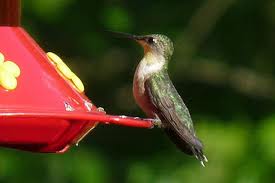
Back to Ar's to assemble our Post for today.  Wow!  What a great day!  Twenty-seven birds!  Even though we can only add one to our year-round list, we still had a blast and were able to spend some quality time together.  Ar's last words to San before she left were, "This day would be perfect if we saw a Ruby Throated Hummingbird at the feeder."  The sentence was not even finished by the time we got to the door and saw, lo and behold, a female Ruby Throated Hummingbird at the feeder!  That makes twenty-eight!  What a great..... no, what a perfect day!